



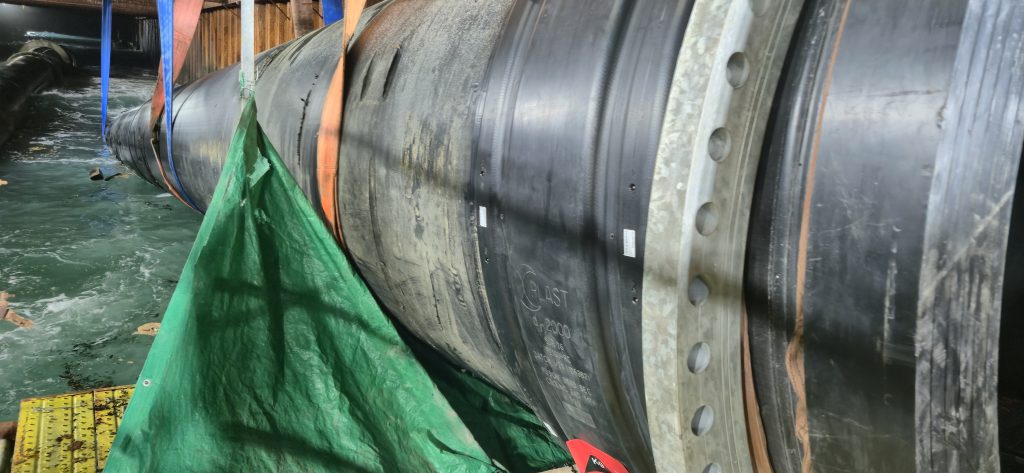
The electrofusion coupler is the standard jointing fitting for polyethylene pipeline systems. It connects two pipe sections through an electrofusion welding cycle that produces a joint with structural and hydraulic continuity equivalent to the pipe itself. Plastitalia manufactures electrofusion couplers in PE100-RC across a dimensional range from DN 20 to DN 2000 – a range that covers the full scale of polyethylene infrastructure, from distribution networks to large-diameter primary mains.
The availability of this complete range from a single manufacturer allows engineers and procurement teams to work with one supplier across all diameters, simplifying supply chain management and ensuring consistent quality between fittings used across different sections of the same system.
Design Features and Dimensional Range
Plastitalia electrofusion couplers are manufactured in PE100-RC, the high-density polyethylene grade with enhanced resistance to slow crack growth. Compared to standard PE100, PE100-RC offers superior performance under localised stress conditions – typical of buried sections in non-homogeneous soils, road crossings and connection points between pipes of different materials – and enables use in the most demanding design classes for water and gas systems.
The dimensional range spans three production segments:
- DN 20 – DN 315: standard production, immediate stock availability, used in water distribution and low-to-medium pressure gas networks.
- DN 355 – DN 630: intermediate range for transmission mains, industrial pipelines and sewage infrastructure.
- DN 710 – DN 2000: large diameter, injection-moulded with dedicated tooling, for primary mains, port infrastructure, desalination systems and complex industrial installations.
Every coupler features integrated fusion resistances embedded in the internal wall, connected to standardised terminals compatible with IPlast welding units and the principal market control units. The fusion zone geometry is engineered to ensure uniform heat distribution across the entire contact surface – a critical factor at large diameters where the thermal mass of the fitting is significant.
Couplers are supplied with external fusion indicators that confirm the completion of the welding cycle.
Applications in Water, Gas and Industrial Systems
The versatility of the Plastitalia PE100-RC electrofusion coupler makes it suitable for a broad spectrum of infrastructure applications.
In water systems, the electrofusion coupler is the standard jointing fitting for transmission and distribution mains. The hydraulic integrity of the electrofusion joint – verifiable through cold pressure testing before commissioning – ensures leak-free performance under variable pressure and seasonal thermal cycling. In network rehabilitation projects, the PE100-RC coupler enables connection of new polyethylene sections to live mains with rapid interventions and without the need for extensive excavation.
In gas distribution systems, the electrofusion coupler is the fitting prescribed by technical standards for joints on medium-pressure polyethylene mains. Electrofusion welding eliminates the risk of joint leakage – the primary concern in gas networks – and produces a joint with certified mechanical resistance and full traceability of the fusion cycle through data logged by the control unit. For PE100-RC gas mains, Plastitalia supplies couplers conforming to EN 1555.
In industrial systems, the Plastitalia coupler is used in aquaculture installations, irrigation systems, geothermal plants, desalination facilities, fire fighting systems, data centre cooling loops and process fluid transport. In these contexts, the ability to produce reliable joints on large-diameter pipelines with reduced site crews – without open flame, without oxidation risk and without the extended cooling times required by butt fusion – is a direct operational advantage that affects both project schedules and costs.
For submarine and offshore applications – as demonstrated in the Indonesia DN 2000 underwater installation – electrofusion welding delivers joints with the same mechanical and pressure resistance as the pipe itself, with no structural discontinuities that could be critical in submerged environments.
Welding Performance and Joint Integrity at Large Diameters
As diameter increases, the technical demands on the electrofusion joint change in ways that require careful attention to fitting design, welding procedure and site management. Plastitalia’s approach to large-diameter electrofusion couplers addresses each of these factors directly.
Thermal management: At large diameters, the volume of material that must reach fusion temperature is significantly greater than at standard distribution sizes. The Plastitalia coupler design distributes resistance elements to achieve uniform heat propagation across the full contact surface.
Pipe end preparation: Joint integrity at large diameters depends critically on the quality of pipe end preparation. Scraping to remove the oxidised surface layer, cleaning with approved solvents and verifying ovality within the coupler’s tolerance band are mandatory steps that must be executed consistently regardless of site conditions. Plastitalia provides welding procedure documentation for large-diameter couplers that specifies each preparation step with the tolerances and verification methods required for compliant execution.
Restraint during fusion: At large diameters, pipe weight and site conditions can create misalignment forces that must be controlled during the fusion cycle. Plastitalia’s technical team provides guidance on clamping and support configurations for large-diameter electrofusion jointing, based on field experience accumulated across projects in multiple countries and environments.
Joint verification. Every electrofusion cycle produces a digital log through the control unit: fusion parameters, ambient temperature, date, time and operator identification. These records are exportable and can be attached to project as-built documentation, providing full traceability of every joint executed. For projects where weld documentation is a contractual requirement – increasingly standard in gas networks and critical infrastructure – this traceability is a baseline requirement that the electrofusion system satisfies as a native feature.
Proven performance at DN 2000: Plastitalia’s DN 2000 electrofusion coupler was developed and produced using injection moulding technology, ensuring the dimensional accuracy and material consistency required for reliable jointing at this scale. The coupler has been deployed in submarine pipeline installations, with on-site technical support from Plastitalia’s team and IPlast control units, demonstrating the system’s capability in demanding project conditions.
Conclusions
The Plastitalia PE100-RC electrofusion coupler is the most versatile and reliable jointing fitting for polyethylene infrastructure, regardless of diameter or application context. A range from DN 20 to DN 2000, PE100-RC material grade, traceable welding and direct technical support: these are the elements that make the Plastitalia coupler the reference component for engineers and contractors where joint reliability is non-negotiable.
Whether for an urban water network, a medium-pressure gas main, a complex industrial system or a submarine installation, Plastitalia offers the right fitting for every diameter and the technical expertise to support correct specification and installation.