



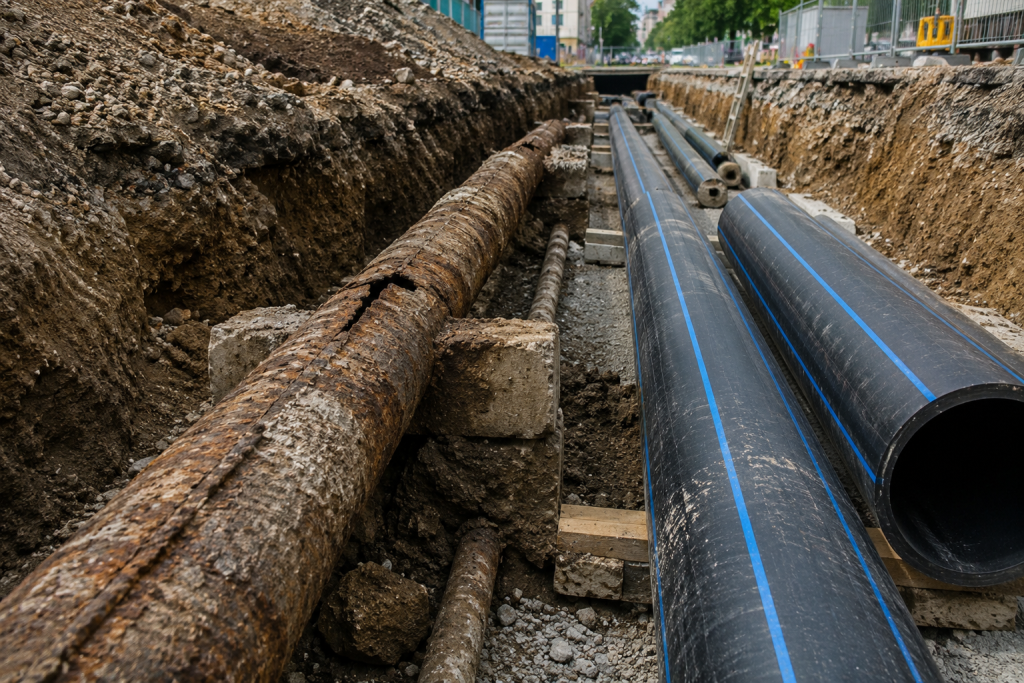
HDPE fittings for brownfield infrastructure upgrades address one of the most operationally demanding scenarios in utility and industrial engineering: improving or replacing ageing pipeline systems without the benefit of a clean installation environment. Unlike greenfield projects, where infrastructure is designed and built from the ground up, brownfield upgrades must work around existing assets, live services, structural constraints, and decades of accumulated complexity. Polyethylene fittings, with their material flexibility, jointing versatility, are increasingly the technology of choice for engineers and contractors managing these projects.
Challenges of upgrading existing utility systems
Brownfield infrastructure upgrades present a fundamentally different set of engineering and logistical challenges compared to new-build projects. The physical environment is rarely predictable: existing asset records may be incomplete or inaccurate, buried services may have shifted from their documented positions, and the condition of legacy pipelines is often unknown until excavation begins. Managing these variables while maintaining service continuity, controlling costs, and meeting programme deadlines requires materials and jointing systems that can adapt to conditions as they are found, not as they were planned.
HDPE fittings are well suited to this environment. Their availability across a wide range of diameters, pressure classes, and geometries, combined with the adaptability of electrofusion jointing, means that solutions can be configured on site to address unexpected conditions without requiring extended supply chain delays or specialist fabrication. This operational flexibility is a material advantage in brownfield contexts where programme certainty is limited and the cost of delay is high.
Aging infrastructure and compatibility issues in brownfield upgrades
The majority of water and gas distribution infrastructure in established urban and industrial areas was installed using materials that are now considered legacy technologies: cast iron, asbestos cement, ductile iron, galvanised steel, and early-generation unplasticised PVC. These materials have different dimensional standards, jointing methods, pressure ratings, and failure modes compared to modern polyethylene systems. Any upgrade programme must address the interface between old and new, and do so in a way that does not introduce new failure points or create maintenance complexity at the transition.
Corrosion is the dominant failure mechanism in metallic legacy systems. Cast iron and ductile iron pipelines lose wall thickness over time through internal corrosion from aggressive water chemistry and external corrosion from aggressive soils. The result is a gradual reduction in structural capacity and pressure rating, punctuated by increasingly frequent burst failures as the pipeline reaches the end of its serviceable life. Asbestos cement pipelines face a different degradation mechanism: the binding matrix softens over time, leading to progressive loss of mechanical strength and increasing risk of catastrophic failure under surge pressure conditions.
When these ageing systems are upgraded using HDPE fittings, the new pipeline section introduces a material with fundamentally different mechanical and chemical properties. Managing the dimensional and mechanical compatibility at the interface requires careful specification of transition fittings and an understanding of the load transfer characteristics at the junction between rigid legacy pipe and flexible polyethylene.
Constraints in urban and industrial Areas for infrastructure upgrades
Urban brownfield projects operate under constraints that have no equivalent in open-field installations. Road closures require traffic management plans and regulatory approval. Excavations must be supported to prevent collapse into adjacent utilities or foundations. Working hours may be restricted to minimise disruption to businesses and residents. Overhead and underground services must be identified and protected before any ground is broken. In industrial facilities, upgrades must often be carried out during planned maintenance shutdowns, with fixed windows that cannot be extended regardless of site conditions encountered.
These constraints drive a strong preference for installation methods that minimise excavation volume and duration. The ability to install or rehabilitate pipeline sections with minimal surface disruption reduces the cost and programme risk associated with traffic management, reinstatement, and service protection measures, making HDPE the practical choice for contractors working in constrained urban environments.
HDPE solutions for retrofit projects
The retrofit application of HDPE fittings in brownfield upgrade projects encompasses a range of technical approaches, from direct replacement of failed sections to progressive rehabilitation of entire distribution zones. The selection of the appropriate approach depends on the condition of the existing system, the operational requirements of the upgrade, and the physical constraints of the installation environment. HDPE systems provide the technical range to support all of these scenarios within a single material and jointing platform.
Transition fittings and hybrid systems for HDPE Brownfield Upgrades
Transition fittings are the critical interface components in any brownfield upgrade where HDPE is introduced into an existing system built from different materials. A transition fitting connects the polyethylene pipeline to a legacy pipe material, typically through a combination of electrofusion or mechanical jointing on the HDPE side and flanged, threaded, or compression connections on the legacy side.
Plastitalia manufactures a comprehensive range of transition fittings covering connections. These fittings are designed to create reliable, long-term connections at the HDPE-to-legacy interface, with configurations appropriate for both above-ground and buried installations. For projects requiring non-standard transition geometries or pressure classes outside the standard range, Plastitalia’s custom fitting capability allows bespoke solutions to be developed and supplied within project-specific timelines.
Hybrid systems, where sections of HDPE pipeline are introduced progressively into an existing legacy distribution system, are a common brownfield upgrade strategy. This approach allows operators to prioritise the replacement of the highest-risk or worst-condition sections while deferring investment in sections that remain serviceable. The result is a system with mixed materials and jointing technologies that must be managed as an integrated whole. HDPE sections within a hybrid system contribute disproportionately to overall reliability improvement, as they eliminate the corrosion and joint degradation failure modes that dominate in the legacy sections they replace.
Enhancing performance without full replacement
Not all brownfield infrastructure challenges require full pipeline replacement. In many cases, the objective is to improve the performance of an existing system, extend its operational life, or adapt it to new service requirements without the cost and disruption of complete replacement. HDPE fittings applied in brownfield upgrade contexts support this objective through targeted interventions that address specific performance gaps while preserving the investment already represented by the existing infrastructure.
Cost optimization in brownfield HDPE Projects
The cost structure of a brownfield infrastructure upgrade is fundamentally different from a greenfield installation. In greenfield projects, material costs typically represent the largest component of total project cost. In brownfield projects, the costs of traffic management, service protection, excavation support, site investigation, and programme contingency frequently exceed material costs by a significant margin. Any approach that reduces the volume of excavation, the duration of surface disruption, or the number of interventions required to complete the upgrade has a disproportionate impact on total project cost.
HDPE systems contribute to cost optimisation in brownfield projects through several mechanisms. The long service life of PE100RC fittings, typically rated at 50 years or more, reduces the frequency of future upgrade cycles and the lifecycle cost of the asset. The elimination of mechanical joints removes the maintenance cost associated with periodic gasket and seal replacement in conventional systems. The availability of couplers and saddle fittings for targeted interventions on existing HDPE sections within a hybrid system reduces the cost of responding to localised failures without requiring full section replacement.
For utility operators and industrial facility managers developing the business case for a brownfield upgrade programme, these cost factors are material inputs to the investment decision. Plastitalia’s system design consultancy service supports clients in quantifying these benefits within their specific project context, providing the technical basis for upgrade specifications and procurement strategies that optimise whole-life cost rather than minimising upfront material expenditure.
Extending asset lifecycle with HDPE Fittings
The primary objective of most brownfield infrastructure upgrade programmes is not simply to restore current performance, but to extend the operational life of the asset base and defer the need for comprehensive replacement investment. HDPE fittings contribute to this objective directly, both as replacement components in sections where legacy materials have reached end of life, and as upgrade elements that improve the performance of sections that remain structurally serviceable.
The chemical inertness of polyethylene prevents the internal corrosion and tuberculation that progressively reduce flow capacity in metallic systems over time.
For industrial systems handling chemically aggressive process fluids, the upgrade from metallic to HDPE pipelines removes the corrosion failure mode entirely, replacing a system with a finite and unpredictable service life with one whose performance is determined by pressure, temperature, and UV exposure rather than by chemical attack. This transition is particularly valuable in sectors such as mining, and water treatment, where the cost of unplanned process interruptions from pipeline failures significantly exceeds the cost of the upgrade investment.
Conclusions
Brownfield infrastructure upgrades represent some of the most technically demanding and operationally complex projects in utility and industrial engineering. The combination of ageing legacy materials, constrained installation environments, live service requirements, and uncertain subsurface conditions demands materials and systems that offer genuine operational flexibility alongside long-term performance reliability.
HDPE fittings for brownfield infrastructure upgrades meet these requirements across the full range of retrofit scenarios: from targeted repairs and hybrid system integration to full trenchless replacement and long-term asset lifecycle extension. Plastitalia’s product range, covering electrofusion and spigot fittings, transition fittings, and custom fabricated solutions for non-standard geometries, provides engineers and contractors with the technical resources to address brownfield upgrade challenges at any scale. System design consultancy is available for projects requiring support from concept through to procurement specification.