



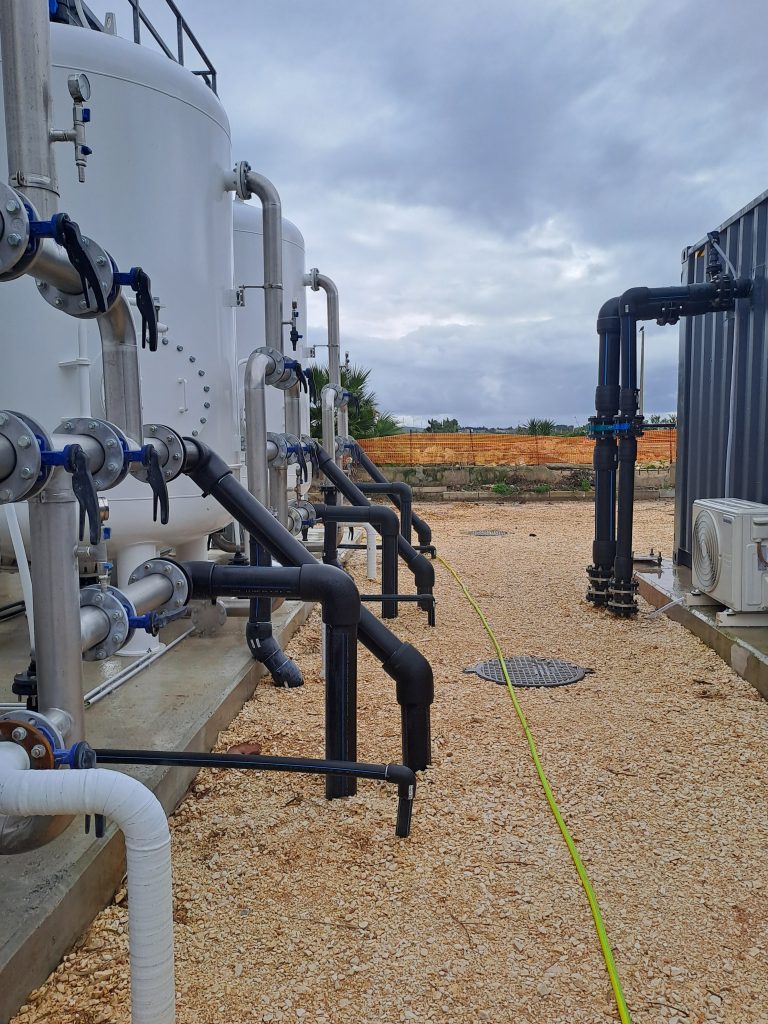
The Nubia desalination plant in Trapani, Sicily, is one of the most significant examples of how PE100-RC polyethylene technology can transform ageing water infrastructure into a modern, reliable, and low-maintenance system. The facility, originally opened in 1995 and left unused for several years, has been brought back into full operation following a substantial upgrade programme in which Plastitalia supplied both standard and custom fittings and provided direct technical support on site throughout the construction phase. The project stands as a concrete demonstration of how the right material choice and the right technical partner can determine the success of a complex infrastructure upgrade, reducing operational costs and improving system reliability for decades to come.
Project Background: Restoring a 1995 Desalination Facility
The Nubia desalination plant represents a strategically important water supply asset for the Trapani district. Built in the 1990s, the facility had been out of service for an extended period, accumulating structural deterioration that made recommissioning conditional on a significant technical upgrade. The decision to restore the existing plant rather than replace it with a new facility required a thorough engineering assessment of which components needed renewal and which technologies would best deliver reliable performance to current standards for the decades ahead.
The operating environment of a desalination plant places specific technical demands on the materials used in its internal distribution systems. Seawater, with its high chloride concentration and biological content, is one of the most aggressive environments for metallic piping. The accelerated corrosion that characterises desalination plants built with steel systems is a primary cause of leakage, service interruptions, and rising maintenance costs over time. In a plant serving an entire water district, these failures have direct consequences for service continuity and for the quality of the water reaching end users.
The Nubia upgrade fits within a broader context of water management optimisation in the Trapani area, where reliable potable water supply is a strategic priority. Restoring an existing facility with updated technology is a choice that responds both to economic criteria, avoiding the capital expenditure of a new build, and to sustainability criteria, maximising the value of infrastructure already in place rather than decommissioning and rebuilding from scratch.
Technical Challenge: Replacing Steel with Polyethylene
The primary technical intervention of the upgrade was the replacement of the steel piping system with a polyethylene one. This decision directly addressed the failure mechanisms that had contributed to taking the plant out of service: corrosion of the metallic pipework, diffuse leakage across the distribution system, and the maintenance burden associated with managing a steel system in a marine environment.
Transitioning from steel to PE100-RC polyethylene in an existing desalination facility is not a standard operation. The internal network geometries of desalination plants are often complex, with configurations that do not correspond to standard catalogue fittings. Connection points between the new polyethylene network and existing process equipment, valves, and civil structures require transition fittings and special components that must be designed and manufactured to project-specific requirements. The ability to develop these components while maintaining material continuity in polyethylene throughout the system is one of the elements that distinguishes a technically capable supply partner from a standard material supplier.
Added to this geometric complexity is the need to ensure full chemical compatibility of the materials with seawater across the different phases of the desalination process: saline feed water at intake, water in various stages of treatment, and potable water at the outlet heading to the district distribution system. PE100-RC polyethylene addresses all of these requirements through its complete chemical inertness to chlorides and biological agents present in marine water, without requiring protective coatings or periodic treatment programmes. This characteristic, which in metallic systems demands a continuous programme of cathodic protection and inspection, is intrinsic to polyethylene and generates no additional management costs throughout the operational life of the system.
A further element of technical complexity concerns the installation phase itself. Working within an existing facility, with civil structures already in place and process equipment that must not be damaged during construction, requires careful planning of operational sequences and the ability to adapt to site conditions as they emerge during execution. In these contexts, the presence of experienced technical personnel directly on site is not an option but an operational necessity.
Plastitalia Solution: Standard and Custom Fittings with On-Site Support
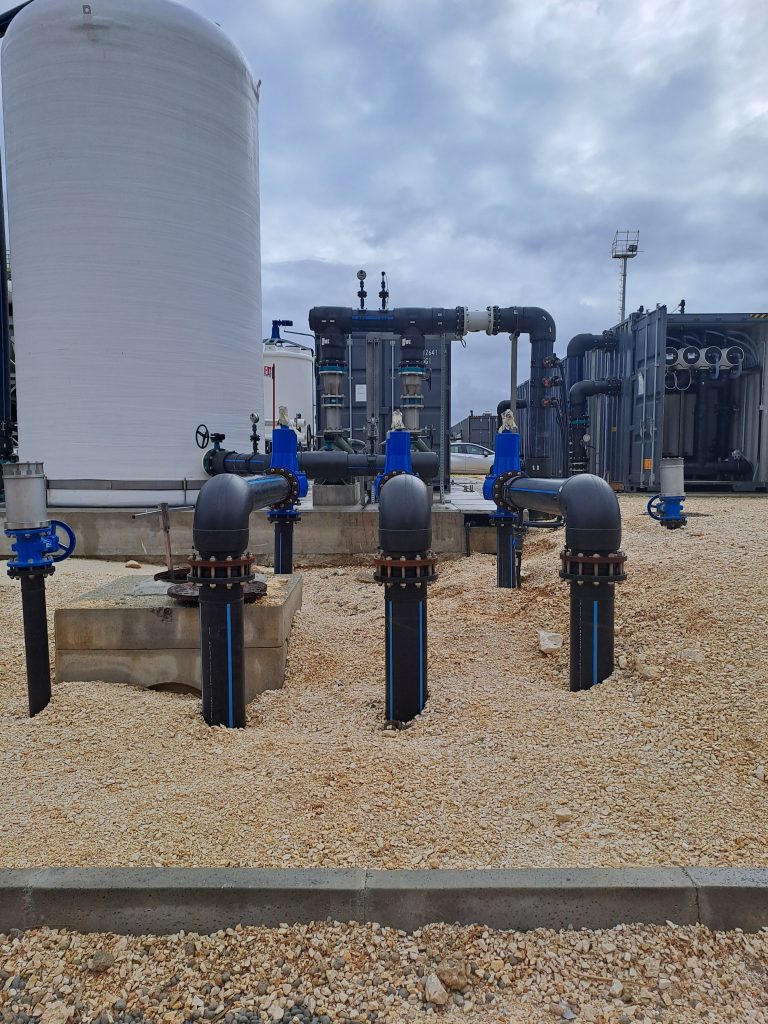
Plastitalia participated in the project with a supply programme combining standard catalogue fittings and custom fittings developed specifically for the geometric configurations of the Nubia plant. This combination reflects the approach Plastitalia takes on technically complex projects: applying catalogue products for standard connections and developing bespoke components for the critical points where non-standard geometries or specific operational requirements make conventional fittings inadequate.
The custom fittings developed for the Nubia project were engineered to account for the specific stresses of the installation environment: operating pressures, thermal conditions, chemical compatibility with the process fluids, and dimensional compatibility with the existing process equipment. Each bespoke component was technically verified before production, with the definition of specific welding parameters to ensure joint quality during installation.
Plastitalia’s contribution extended well beyond product supply. The technical team supported the client directly on site during the preliminary phases of construction, verifying the operational conditions of the plant, assisting in defining the technical specifications for the custom fittings, and providing operational guidance for the installation of components under the specific conditions of the site. This direct on-site assistance is a key element of Plastitalia’s approach to major infrastructure projects, where the quality of the supply and the quality of the installation are equally critical to the success of the outcome.
The ability to resolve unexpected technical challenges with expertise and speed as they arise during construction is one of the value elements that distinguishes Plastitalia’s contribution from standard material supply. When site conditions differ from what was anticipated in the design phase, having a technical team with deep product knowledge available to support decision-making in real time is what allows the project to stay on programme without compromising the quality of the installation.
Outcomes: Corrosion Resistance, Reduced Leakage and Lower Maintenance
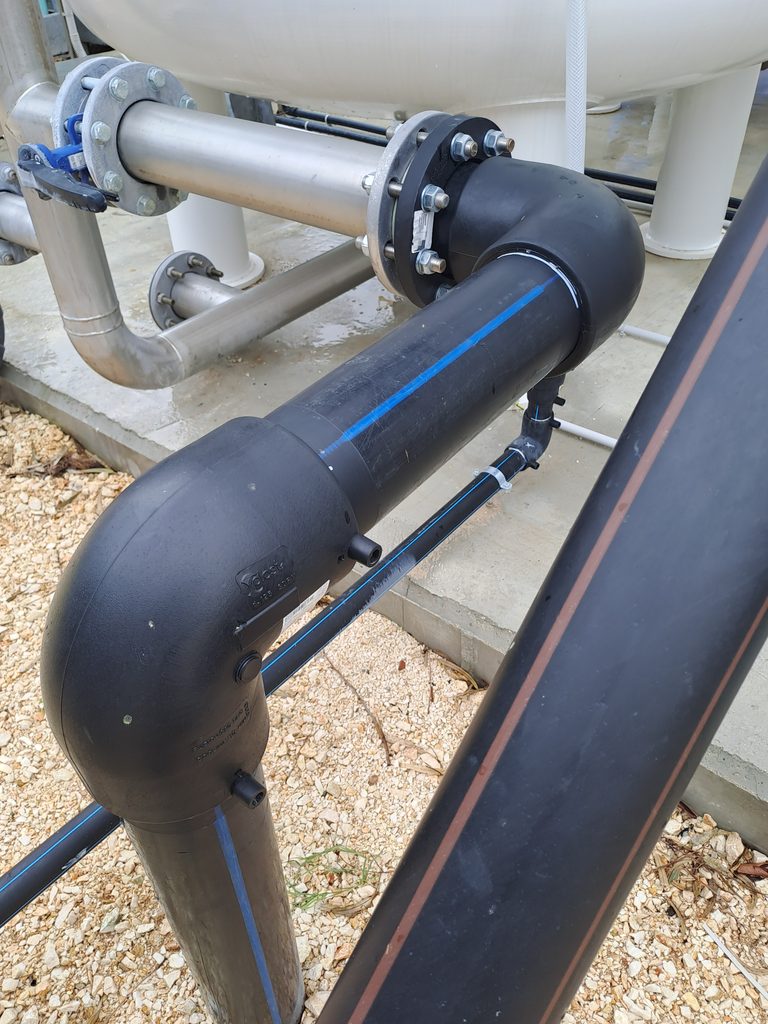
The replacement of the steel system with a PE100-RC polyethylene network has delivered concrete and measurable improvements to the operational performance of the plant. Corrosion has been eliminated as a degradation mechanism: polyethylene is chemically inert to seawater and to the agents present across the different phases of the desalination process, and requires none of the periodic protection treatments necessary to maintain the integrity of metallic pipework in a marine environment. This removes one of the most significant cost items in the management of a desalination facility, which in the previous system demanded both scheduled and unscheduled interventions linked to the progressive deterioration of the pipework.
Leakage across the distribution network has been reduced through the structural continuity provided by electrofusion-welded joints, which create a molecular bond between fitting and pipe with no mechanical sealing elements subject to relaxation over time. A correctly installed polyethylene system does not exhibit the progressive leakage points that characterise steel systems with threaded or flanged joints in marine conditions. Reduced leakage has a direct impact on plant efficiency and on the quality of the service delivered to the district.
Maintenance requirements have been significantly reduced. The absence of corrosion and the stability of hydraulic performance over time eliminate the periodic inspections and section replacements that represented a significant share of the operating costs of the original system. This translates into higher plant availability and more predictable, lower management costs throughout the operational life of the new network. For a strategic facility like a desalination plant serving an entire water district, this predictability of operational costs has value well beyond the immediate financial saving.
The Nubia desalination plant in Trapani now stands as a concrete example of how PE100-RC polyethylene technology, combined with custom fittings and direct technical support, can return an existing water infrastructure asset to service with superior performance and lower operating costs than the original system it replaced. The project also demonstrates that choosing polyethylene is not a decision reserved for new construction: it can be the most effective solution for the rehabilitation of existing facilities where original materials have reached the limits of their operational life.
Conclusions
The Trapani desalination project demonstrates the value of an integrated approach to fitting supply for complex infrastructure: standard products for routine connections, custom components for critical configurations, and direct technical support on site to ensure that supply quality translates into installation quality. Plastitalia’s ability to cover the full cycle, from custom fitting design to on-site assistance during installation, is the factor that enabled the Nubia upgrade to be completed with the expected results.
For engineers and technical managers working on desalination facilities or marine water infrastructure, Plastitalia is available for dedicated technical consultation from the earliest stages of the project, supporting the definition of component specifications and the evaluation of solutions best suited to the specific operating conditions of the facility.