



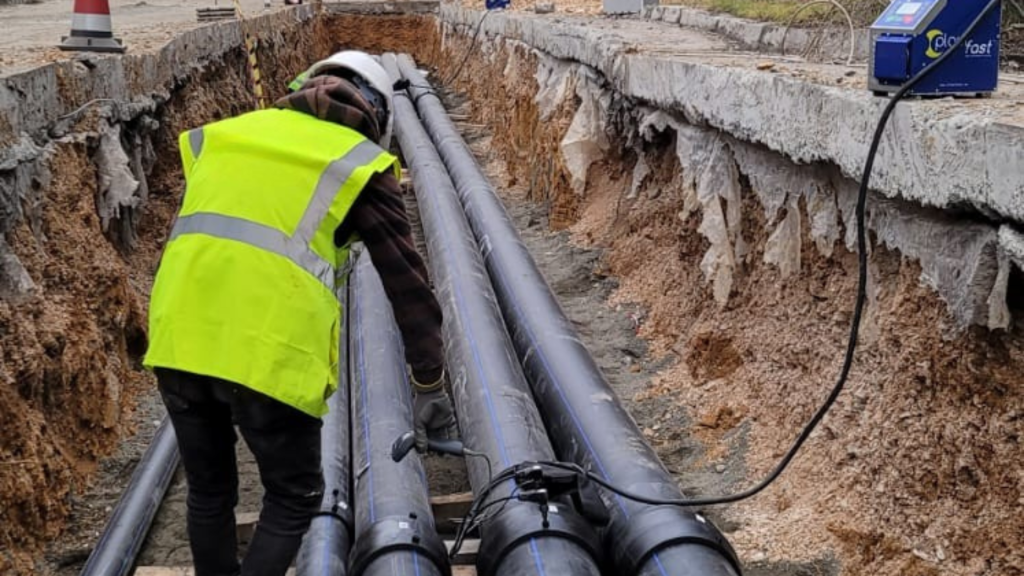
Urban environments are becoming increasingly complex, both above and below ground. As cities expand, the demand for efficient, reliable, and adaptable infrastructure systems continues to grow. Underground spaces, once relatively simple, are now densely packed with multiple utility systems, including water, gas, telecommunications, and power distribution.
In this context, HDPE fittings for urban underground systems offer a strategic advantage. Their unique material properties and installation flexibility make them ideal for addressing the technical and logistical challenges of modern urban infrastructure. This article explores the complexity of underground urban systems, the advantages of HDPE in confined environments, and how to optimize installation and long-term performance.
Complexity of Underground Urban Infrastructure
Urban underground systems are among the most challenging environments for infrastructure development. Limited space, overlapping utilities, and strict regulatory requirements demand solutions that combine performance, adaptability, and reliability.
One of the primary challenges in high-density urban areas is the limited availability of underground space. Multiple systems often share the same corridors, including water pipelines, gas distribution lines, electrical conduits, and telecommunications networks. This overlap creates significant design and installation constraints. Engineers must ensure that each system operates independently while maintaining safety and accessibility. HDPE fittings for high-density urban underground systems provide a compact and versatile solution that supports efficient routing even in highly congested environments.
Their lightweight structure and reduced footprint allow for easier positioning and alignment during installation. This is particularly valuable in narrow trenches or areas with restricted access, where traditional materials may be difficult to handle. Urban soils are also subject to differential settlement, vibration from traffic and construction activity, and thermal cycling across seasons. Unlike rigid piping systems, HDPE distributes stress uniformly along the pipeline. Fusion-welded connections create a monolithic joint structure with no mechanical weak points, reducing the risk of leakage and localised failure over time.
Dense urban infrastructure also increases the risk of accidental damage during installation and maintenance. Any disruption to one system can impact others, leading to costly downtime and potential safety hazards. The flexibility of HDPE helps absorb external stresses, reducing the likelihood of damage caused by ground movement, traffic loads, or nearby construction activities.
HDPE Advantages in Confined Installations
Confined urban spaces require materials that can adapt to challenging conditions without compromising performance. HDPE stands out as a solution that meets these requirements while offering additional operational benefits.
Flexibility is a key advantage of HDPE systems. Unlike rigid materials, HDPE can bend and adapt to irregular layouts, making it easier to navigate around existing infrastructure. This reduces the need for extensive excavation and simplifies installation in constrained spaces. Electrofusion and butt fusion techniques create strong, leak-free connections that require minimal working space. These methods also ensure consistent joint quality, which is essential in critical infrastructure applications.
The ability to create a continuous pipeline with minimal joints enhances system efficiency and reduces potential failure points. This is particularly important in urban environments where access for maintenance may be limited. For applications requiring enhanced performance in demanding buried conditions, PE100RC fittings offer superior resistance to slow crack growth and environmental stress cracking, making them well suited to high-density urban installations where ground loads and soil aggressiveness are significant factors.
Urban infrastructure is also constantly exposed to external loads, including traffic, construction activities, and environmental stress. HDPE fittings offer excellent resistance to impact and stress. Their ability to distribute loads evenly across the pipeline reduces the risk of localised failures, ensuring consistent performance even under prolonged stress conditions. This reliability contributes to the long-term stability of urban utility systems.
Optimizing Installation in Urban Systems
Efficient installation is a critical factor in urban infrastructure projects. Minimizing disruption, reducing costs, and ensuring safety are key priorities for contractors and municipal operators.
Traditional installation methods often require extensive excavation, which can disrupt traffic, businesses, and daily life in urban areas. HDPE fittings for urban underground systems support alternative installation techniques that reduce surface impact. Trenchless technologies, such as horizontal directional drilling and pipe bursting, are fully compatible with HDPE systems. These methods allow pipelines to be installed or replaced with minimal excavation, preserving existing infrastructure and reducing project timelines.
The lightweight nature of HDPE components also simplifies handling and installation, reducing the need for heavy equipment and extensive site preparation. Electrofusion control units read welding parameters directly from the fitting barcode, ensuring that every joint is executed to the correct specification and that a digital record of each welding cycle is automatically generated for network documentation purposes.
Accessibility is a critical consideration in urban infrastructure design. Systems must be easy to inspect, maintain, and upgrade over time. The use of fusion-welded joints reduces the likelihood of leaks and failures, minimising the need for frequent interventions. The adaptability of HDPE systems also supports future modifications and expansions. As cities evolve, infrastructure must accommodate new demands without requiring complete system replacement. HDPE fittings provide the flexibility needed to achieve this.
Why Choose Plastitalia for Urban Underground Systems
Selecting the right partner is essential for the success of urban infrastructure projects. Plastitalia offers a comprehensive range of HDPE fittings for high-density urban underground systems, engineered to meet the highest performance standards across water, gas, and industrial applications.
Each product is designed to ensure compatibility with modern installation techniques and to deliver reliable performance in complex environments. Plastitalia’s commitment to quality and innovation ensures that every fitting meets strict international standards and is produced across the full diameter range to support projects of any scale.
In addition to product excellence, Plastitalia provides technical support to assist clients throughout the project lifecycle. This includes guidance on system design, fitting selection, and custom solutions for non-standard geometries or pressure requirements. For contractors, engineers, and utility operators, this means working with a partner that understands the challenges of urban infrastructure and provides solutions that deliver long-term value.
Conclusions
The evolution of urban environments requires a new approach to infrastructure design and implementation. High-density underground systems demand materials and solutions that combine flexibility, durability, and efficiency.
HDPE fittings for high-density urban underground systems offer a proven solution to these challenges. Their ability to adapt to complex layouts, withstand external stress, and support efficient installation makes them an ideal choice for modern urban projects. For B2B stakeholders, investing in HDPE solutions is a strategic decision that enhances system performance, reduces operational risks, and supports sustainable urban development.