



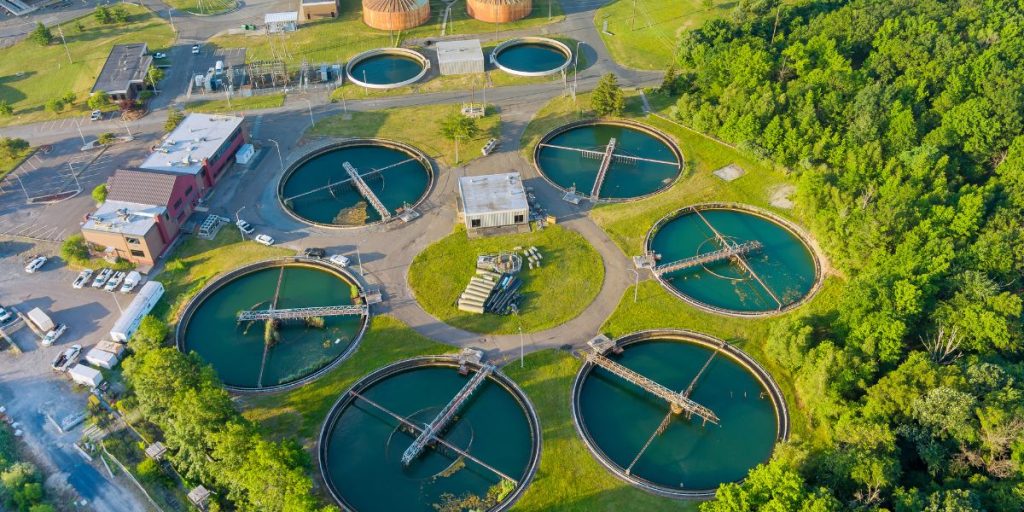
Wastewater lines represent some of the most demanding environments in municipal and industrial infrastructure. Continuous pressure cycles, aggressive effluents, and critical service conditions require piping systems engineered for absolute reliability.
HDPE fittings for wastewater lines provide a technically robust solution, ensuring hydraulic continuity, structural integrity, and long-term operational safety across the entire system.
Manufactured from PE100 material and assembled through fusion welding, these systems deliver leak-free performance and exceptional resistance to mechanical and chemical stress. For engineers, utilities, and contractors, HDPE fittings represent a strategic choice for modern wastewater infrastructure.
Pressure Resistance in Sewage Systems
Frequent pump start-ups, pressure surges, and variable flow regimes generate cyclic stress along the pipeline. HDPE fittings for sewer rising mains and pumped wastewater lines are specifically designed to manage these dynamic loads without loss of performance.
Managing Pressure Cycles
PE100 HDPE fittings maintain uniform mechanical behavior across the pipe and joint, preventing stress concentration at connection points.
The fusion-welded joint becomes structurally homogeneous with the pipe, allowing the system to absorb pressure variations without micro-cracking or fatigue.
Structural Stability Under Continuous Operation
Unlike rigid materials, HDPE does not suffer from brittle failure when exposed to repeated pressure cycling. HDPE fittings for sewer systems maintain dimensional stability even in systems operating continuously or intermittently.
This pressure resilience is essential for:
- municipal pumping stations
- industrial wastewater transfer lines
- emergency bypass systems
The result is predictable hydraulic performance and reduced risk of unplanned downtime.
Leak Prevention in Critical Wastewater Infrastructure
Leakage in wastewater lines is not merely a maintenance issue. It can result in soil contamination, groundwater pollution, and costly environmental remediation. HDPE fittings for wastewater lines address leakage at its primary source: the joint.
Monolithic Fusion Joints Without Weak Points
Electrofusion and butt fusion welding create permanent, monolithic connections between pipes and fittings. No gaskets, bolts, or mechanical seals are involved.
This eliminates the most common failure points found in traditional wastewater systems.
The fused joint becomes a single continuous structure that resists both internal pressure and external infiltration, even in saturated or unstable soils.
Performance With Contaminated and Abrasive Effluents
Pumped wastewater often contains solids, abrasive particles, and chemical residues that accelerate wear in conventional materials. HDPE fittings for sewer sysfems offer a smooth internal surface that reduces turbulence and prevents the accumulation of debris at connection points.
This characteristic minimizes:
- localized erosion
- sediment build-up
- pressure losses
- progressive joint degradation
As a result, leak risks are reduced over the entire service life of the pipeline.
Traceability and Installation Control
Modern fusion equipment allows full traceability of each welded joint. Welding parameters can be monitored, recorded, and verified, ensuring installation quality even across large-scale rehabilitation or expansion projects.
For utilities and operators, this provides documented assurance of system integrity and supports long-term asset management strategies.
Long-Term Reliability in Municipal Pumping Stations
Municipal pumping stations represent critical nodes within wastewater systems. Failure at these points can disrupt entire service areas. HDPE fittings for sewer systems and pumped wastewater lines are engineered to deliver reliability over decades of operation.
Resistance to Chemical and Biological Aggression
Wastewater environments expose pipelines to a wide range of aggressive agents, including hydrogen sulfide, acids, and biological by-products. PE100 HDPE demonstrates excellent resistance to chemical attack and stress cracking, maintaining mechanical properties even under prolonged exposure.
This makes HDPE fittings particularly suitable for:
- raw sewage pumping stations
- industrial effluent handling
- mixed municipal-industrial systems
- treatment plant inlet and outlet lines
Unlike metallic systems, HDPE does not corrode, eliminating the need for coatings or cathodic protection.
Flexibility and Structural Adaptability
Ground settlement, vibration from pumps, can induce mechanical stress in rigid piping systems. HDPE fittings for sewer rising mains provide inherent flexibility, allowing the pipeline to adapt to movement without compromising joint integrity.
This adaptability reduces:
- cracking due to ground movement
- joint separation under vibration
- maintenance interventions over time
The system remains operational even under challenging site conditions.
Reduced Maintenance and Lifecycle Cost
The durability of HDPE fittings translates directly into lower total cost of ownership. With no corrosion, minimal wear, maintenance intervals are extended and emergency repairs become rare.
For municipalities and industrial operators, this reliability supports long-term planning, predictable operating budgets, and improved service continuity.
Engineering Confidence for Wastewater Infrastructure
HDPE fittings for sewer wastewater systems provide engineers and utilities with a technically sound, future-proof solution. Pressure resistance, leak prevention, and long-term durability are embedded into the material and jointing technology itself.
The homogeneous structure of PE100 fittings and electrofusion joints ensures consistent mechanical performance across the entire system, even in high-stress pumping conditions and variable flow regimes. This reliability supports accurate hydraulic design and reduces uncertainty during both design and operation phases.
As wastewater systems evolve to meet growing urban demand and stricter environmental standards, HDPE systems offer the reliability and performance required to protect both infrastructure investment and public health, while supporting sustainable asset management strategies over the full lifecycle of the system.
Conclusions
HDPE fittings for wastewater lines represent a technically sound and future-proof solution for modern wastewater infrastructure. Their ability to withstand continuous pressure, prevent leakage, and maintain structural integrity over time makes them particularly suitable for critical pumped systems where reliability is essential.
Thanks to PE100 material properties and electrofusion joint technology, HDPE systems ensure consistent performance even under aggressive operating conditions, reducing maintenance needs and limiting operational risks for utilities and operators. This translates into lower lifecycle costs, improved service continuity, and greater environmental protection.
For municipalities, engineers, and contractors involved in wastewater projects, choosing HDPE fittings means investing in durable, efficient, and safe sewer systems designed to meet today’s demands and tomorrow’s infrastructure challenges.