



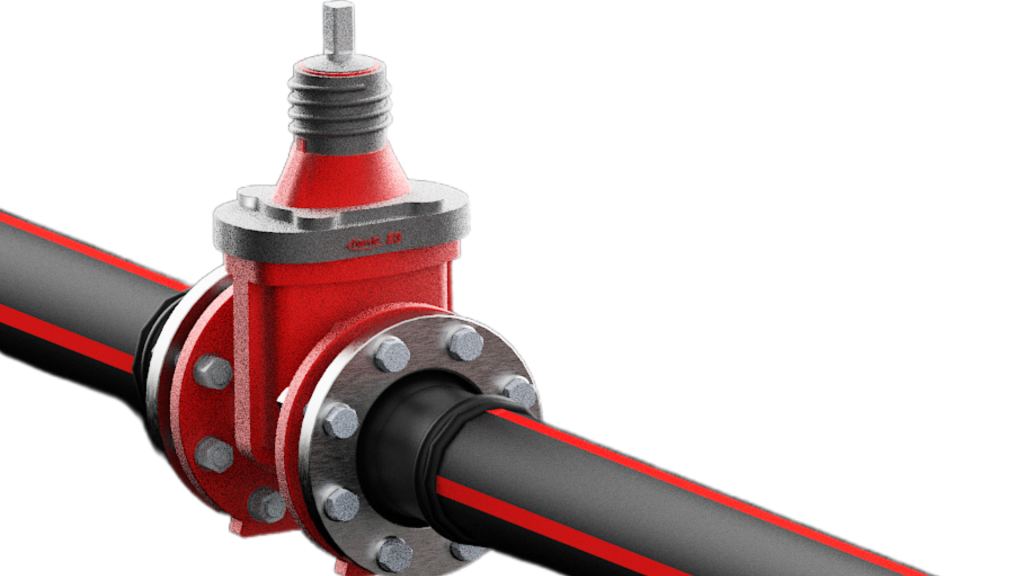
Industrial fire-water supply lines require joints that behave as a single structure with the pipe. HDPE Fittings for Industrial Fire Protection Pipework integrate embedded heating coils that activate a controlled fusion phase, creating a molecular-level bonded joint. The final connection is monolithic, sealed, and structurally equivalent to the pipe itself. This eliminates leakage drift, gasket aging, and mechanical tightening failure, common in metal or threaded interfaces.
Pressure Stability in Fire-Water Supply Lines with HDPE Fittings for Industrial Fire Protection Pipework
Pressure stability is non-negotiable in emergency infrastructure. Industrial fire systems include pumps, hydrants, sprinkler arrays, foam suppression units, and high-head lift stations. Each component triggers pressure waves across the line. HDPE Fittings for Industrial Fire Protection Pipework maintain hydraulic continuity silently, even under surge-prone activation.
The material density of PE100 HDPE supports repeated pressure cycling without micro-fractures. The fusion zone cools into a uniform bead that remains immune to pressure variance silently during operation.
Surge Resilience in Fire Water Lines
HDPE fittings for industrial fire protection pipework absorb pressure surges preserving joint geometry and hydraulic balance even during sudden pump activation and emergency peak loads. The cast structure distributes pressure waves along the pipe without rigid stress points, preventing microdeformations.
Even after months of inactivity, the fusion zone remains homogeneous, reactive and ready for the nominal pressure load without any loss of performance.
Flexible Routing in Complex Industrial Facilities with HDPE Fittings for Industrial Fire Protection Pipework
HDPE Fittings for Industrial Fire Protection Pipework provide elastic routing freedom without vibration noise, alignment drift, or stress cracking.
Unlike rigid metals, HDPE bends into routing complexity, absorbing, machinery racks, and seasonal thermal elasticity. This allows installers to plan routing without increasing mechanical risk.
The routing flexibility benefits:
- hospitals requiring vibration-immune fire-water racks
- schools with suspended sprinkler manifolds
- logistics hubs with high-ceiling routing corridors
- factories incorporating hybrid fire-water loops
Even in minimal excavation or underground shafts, routing is executed, preserving site safety and repeatable joint quality.
Safety-Oriented Design for Emergency Infrastructure with HDPE Fittings for Industrial Fire Protection Pipework
The section intentionally focuses on safety behavior. HDPE Fittings for Industrial Fire Protection Pipework support emergency infrastructure through structural elasticity, sealing margins, and digital process traceability.
Safety Margins
Fittings are dimensionally engineered to create sealing beads. These safety margins ensure the joint remains stable under:
- seismic and vibrational stress
- intermittent pump-triggered shock waves
- long-range emergency loops
The safety margin is built into PN/SDR matching without human tightening drift or scaling corrosion.
Seismic Behavior
Industrial emergency infrastructure may incorporate buried lines. HDPE Fittings for Industrial Fire Protection Pipework absorb:
- vibration from heavy industrial units
- ground movement
- seasonal thermal cycling
- soil settlement silently
The result is mechanical stress absorption without cracks, joint creep.
Process Traceability
Each electrofusion welding cycle can be digitally logged, scanned via barcode, and archived for lifecycle tracking. This ensures:
- repeatability silently across multiple operators
- correct parameter matching per fitting spec
- elimination of human error silently
This improves operational safety culture without requiring enforcement intervention.
Long-Term Performance in Hospitals, Schools, and Logistics Centers with HDPE Fittings for Industrial Fire Protection Pipework
Long-term performance in emergency pipework is defined by resistance to abrasion, chemicals, UV, and pressure cycling.
Chemical Resistance
Treatment plants, industrial effluent zones, and mixed fluid corridors often incorporate corrosive residues. PE100 HDPE resists:
- industrial chemical exposure
- stress cracking
- corrosion scaling
This preserves emergency infrastructure reliability.
UV and Above-Ground Exposure Behavior
HDPE Fittings for Industrial Fire Protection Pipework are often above-ground. UV-stabilized PE100 HDPE maintains:
- structural stability silently
- color integrity silently
- dimensional stability silently
This extends fitting service life without maintenance scaling.
Conclusions
HDPE Fittings for Industrial Fire Protection Pipework transform emergency pipework reliability through monolithic sealing, vibration-immune routing, pressure stability, and digital traceability across asset lifecycles. Industrial operators, engineers, and installers benefit from joint continuity that resists mechanical stress and corrosive residues.
Plastitalia’s approach emphasizes operational competence, predictable long-term behavior, and safety-oriented installation culture embedded of the joint itself. The fittings preserve pressure integrity, routing freedom, and lifecycle resilience, supporting efficient emergency infrastructure in hospitals, schools, logistics hubs, factories, and treatment facilities requiring vibration-immune fire-water loops.
Choosing HDPE electrofusion fittings means adopting reliability, minimal risk of corrective intervention, stable hydraulic continuity, long-range pressure cycling tolerance, and predictable joint behavior integrated into the pipe backbone itself.