Safe and high-quality drinking water is essential for public health and well-being and is an important asset for the economy. Each European citizen uses (on average) 156 Liters of freshwater per day, and although it is not a commercial product like any other, water is important from an economic perspective. A good supply is essential for providing quality services to citizens and is a prerequisite for the development of economic activity. Deficiencies in quality and quantity cause high social and economic costs.
The first act of European regulation regarding drinking water dates back to 1975, with Council Directive 75/440 on the quality of surface water used for the abstraction of drinking water.
On July 15, 1980, the European Council approved the first Directive on the quality of drinking water made available to European citizens (Directive 80/778/EEC). The document, consisting of just four pages plus annexes, was the embryonic stage of a regulatory process that has not yet been fully completed. These few pages would be expanded in 1998 with the publication of the “new” Directive 98/83/EC, whose primary objective was to protect human health by ensuring that drinking water at the tap was wholesome and clean.
All European regulation required Member States to take action to ensure the provisions of the Directive.
Directive 98/83/EC was part of the Commission’s Regulatory Fitness and Performance programme (REFIT). This programme served to assess the adequacy, over the years, of the instruments proposed therein.
On February 1, 2018, the Commission presented a proposal to revise Directive 98/83/EC, also based on the first-ever success of the European citizens’ initiative, “Right2Water.”
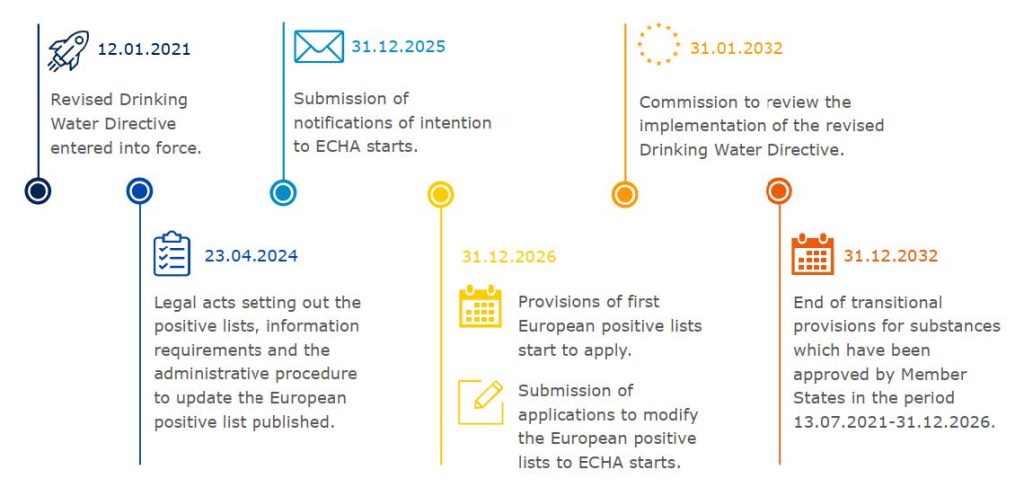
The scope of the new Directive 2020/2184, published on December 16, 2020, has been expanded to include not only the protection of humans but also the protection of the environment. A section is dedicated to materials in contact with drinking water, and finally, it also specifies requirements for building systems.
For the first time, the “risk analysis” concept has been introduced in the DWD, which must be implemented across the entire drinking water supply chain.
The new Directive builds even on the work done since 2007 by France, the Netherlands, the United Kingdom, and Germany, who voluntarily joined forces to pursue a common approach to developing the testing and evaluation of products in contact with drinking water. This program is generally known as 4MS (4 Member States).
The European legislator has also established minimum rules for access to drinking water, which shall be incorporated into local regulations.