



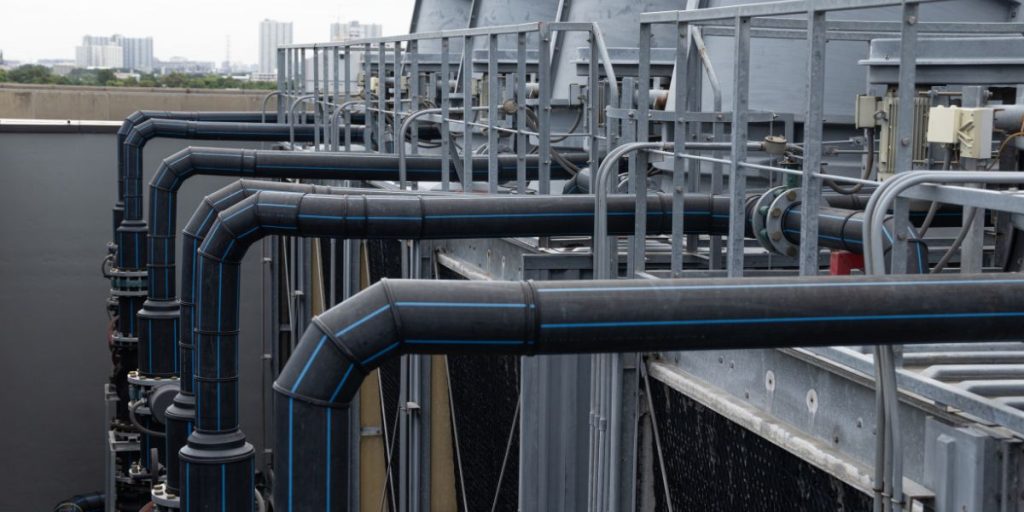
HDPE fittings represent a strategic choice for chemical-resistant process piping, offering long-term stability, mechanical strength and excellent compatibility with aggressive industrial media. In environments where corrosion, pressure cycling and chemical exposure compromise traditional materials, PE100 provides a reliable and efficient alternative.
This article examines three key aspects that guide the design and management of PE100-based industrial systems:
• PE100 stability in corrosive industrial environments, with insights into chemical resistance, mechanical behavior and thermal tolerance;
• the advantages of electrofusion joints in high-risk fluid transfer lines, focusing on precision, safety;
• material selection criteria for complex industrial environments, aimed at optimizing performance, service life and compatibility with existing plant configurations.
This technical overview provides engineers, operators and plant managers with a solid foundation for evaluating the adoption of PE100 in the most demanding industrial process applications.
PE100 Stability in harsh Industrial media
PE100 is widely recognized as one of the most dependable thermoplastics for chemical-resistant process piping. Its high-density molecular structure provides excellent resistance to aggressive fluids, mechanical loads, and thermal fluctuations, ensuring consistent performance in continuous industrial operations.
These characteristics make PE100 fittings a preferred choice across sectors such as chemical processing, wastewater treatment, mining, energy production, and corrosive industrial manufacturing environments.
Chemical Resistance
PE100 maintains dimensional stability and mechanical strength even when exposed to acids, alkaline solutions, saline mixtures, and aggressive industrial by-products. Its inherent chemical resistance eliminates the need for protective coatings, corrosion inhibitors, or cathodic protection systems typically required for metal pipes.
This simplifies system design and reduces long-term maintenance, especially in applications where corrosion could:
• compromise safety,
• degrade product purity,
• reduce pipeline life cycle,
• or increase unplanned downtime.
Mechanical strength under continuous load
Industrial pipelines frequently experience irregular operating conditions: pressure variations, cyclic loads, sudden flow changes and mechanical vibration from pumps or rotating equipment.
Its elasticity helps dissipate shock loads and reduce the risk of fracture, ensuring stable operation even in scenarios involving:
• dynamic pump surges,
• pressure fluctuations across complex plant layouts,
• or soil settlement in buried installations.
This combination of flexibility and mechanical reliability makes PE100 an ideal choice for process piping systems requiring long service life under demanding conditions.
Temperature and UV resistance
Although many process piping systems are installed indoors, a significant portion run across outdoor zones, chemical yards, or exposed industrial structures. PE100 fittings maintain reliable performance across a wide temperature range and resist degradation caused by environmental exposure.
UV-stabilized formulations protect the material from sunlight-induced oxidation, ensuring that system integrity is preserved even in:
• open-air industrial plants,
• rooftop installations,
• coastal facilities with intense solar radiation,
• areas subject to rapid temperature changes.
This stability supports long-term infrastructure planning and reduces the frequency of component replacement, especially in facilities where downtime must be minimized.
Electrofusion Joints for High-Risk fluid transfer
Electrofusion joints represent one of the most secure connection methods for process piping exposed to corrosive or hazardous media. The fusion mechanism ensures molecular bonding between the pipe and the fitting, creating a fully sealed structure capable of withstanding both internal pressure and chemical exposure.
Precision Joining for sensitive Industrial applications
In sectors where fluid containment cannot be compromised—such as industrial wastewater treatment and energy facilities—electrofusion fittings offer unmatched reliability.
The embedded heating coils ensure uniform melt distribution, minimizing localized stress points and eliminating potential leak paths commonly found in mechanical or gasket-based connections.
Operational traceability of digital welding
Electrofusion procedures include digital control units capable of scanning barcodes, adjusting parameters automatically, and recording full welding logs.
This ensures:
• complete process traceability,
• reduced human error,
• documentation for audits and long-term asset management.
This documented verification is an essential component of safety and regulatory compliance.
Long-Term integrity in corrosive environments
Electrofusion fittings maintain their sealing performance even when exposed to aggressive chemicals, or elevated humidity levels.
Because the joint becomes a homogeneous material structure, there are no metallic parts susceptible to attack, nor gaskets that require replacement.
This ensures operational continuity and drastically reduces unplanned maintenance in facilities handling corrosive media.
Optimizing Material selection
Choosing the correct material is critical for ensuring the reliability of industrial process piping. PE100 fittings provide a balanced combination of chemical resistance, structural stability and installation flexibility that supports long-term plant performance.
Selecting the PE100
Different industrial applications may require specific performance characteristics. PE100 is suitable for:
• high internal pressure requirements,
• elevated temperatures,
• abrasive particulate presence in process streams,
• long-term outdoor exposure.
This versatility allows system designers to create piping systems that match operational constraints without resorting to heavier or more complex metallic alternatives.
Design considerations for Industrial layouts
Industrial plants often involve intricate routing, elevation changes, and confined installation zones. PE100 fittings support these constraints thanks to:
• flexibility for navigating complex paths,
• reduced weight for elevated or suspended runs,
• simplified handling in restricted corridors or equipment rooms,
• compatibility with automated and manual electrofusion methods.
These factors reduce installation time and labor requirements, improving project efficiency.
Lifecycle and sustainability advantages
PE100 greatly simplifies long-term asset management due to:
• low maintenance requirements,
• resistance to corrosion and scaling,
• long operational lifespan,
In facilities increasingly focused on environmental compliance and operational efficiency, these characteristics contribute to measurable reductions in lifecycle cost.
Conclusion
The use of HDPE fittings in industrial process piping provides operators and engineering teams with a reliable, long-term solution for environments where corrosion, mechanical stress and thermal fluctuations threaten material integrity. PE100 combines chemical inertness, structural stability and installation versatility, ensuring consistent performance across a wide range of industrial applications.
Electrofusion technology enhances these advantages through precise, making it particularly suitable for high-risk fluid transfer lines and critical process systems. The ability to monitor, document and validate each fusion cycle ensures full operational traceability and supports compliance with internal quality protocols.
When properly designed and installed, PE100 systems contribute to improved resource efficiency, safer operations and a measurable reduction in lifecycle costs.
For engineering teams planning upgrades, expansions or rehabilitation projects, PE100 industrial fittings represent a high-value choice capable of supporting both current and future performance requirements within complex industrial environments.