



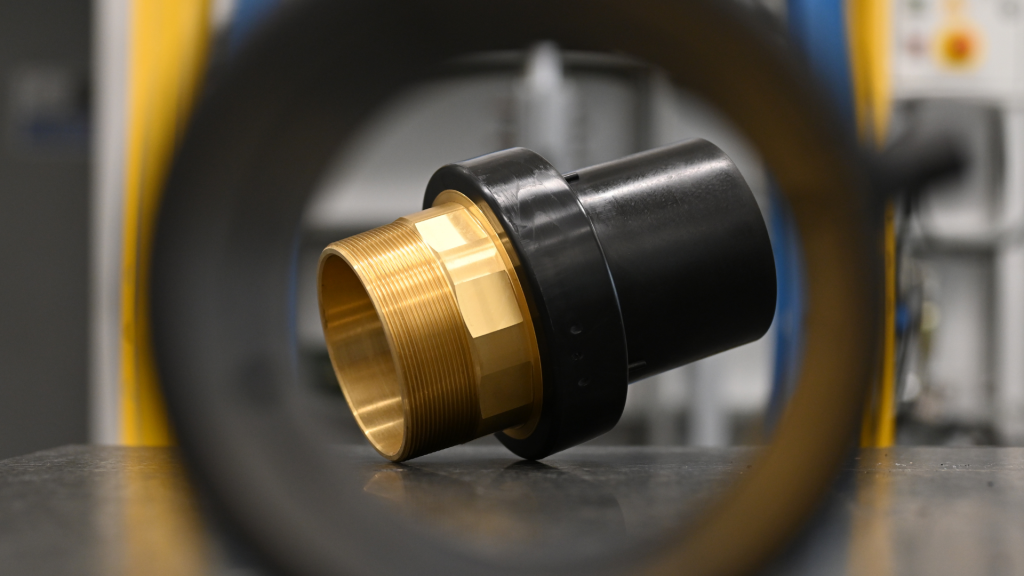
Modern infrastructure for water, gas, and industrial distribution often combines different materials such as polyethylene and metal. These mixed-material systems require highly reliable connections to ensure hydraulic integrity, pressure resistance, and long-term durability.
PE100 transition fittings provide an engineered solution to achieve safe, leak-free connections between polyethylene and metallic components. Designed in compliance with international standards, they ensure stable mechanical performance and full compatibility with demanding environments and operating pressures.
This article explores how PE100 transition fittings improve efficiency and reliability across water, gas, and industrial systems, focusing on PE-to-metal connections.
PE-to-Metal Connections for Distribution Systems
Connecting polyethylene to metal has traditionally presented challenges related to sealing, strength, and thermal expansion. PE100 transition fittings ensures full mechanical and hydraulic compatibility between materials.
Each fitting integrates a PE100 body—known for its flexibility, corrosion resistance, and weldability—with a metallic insert, typically manufactured in brass, stainless steel. This design ensures that each side of the fitting performs optimally under its specific operating conditions.
The result is a high-performance component capable of providing long-lasting, leak-free operation in water supply networks, gas distribution lines, and industrial installations. The smooth transition between polyethylene and metal sections preserves flow efficiency.
Reliable welding of materials for Leak-Free Performance
The transition between polyethylene and metal is created through weldings, forming a permanent, uniform joint between the two materials.
This design ensures leak-free operation both in buried networks and in above-ground applications, minimizing the risk of failure even under cyclic loading or temperature variation. Furthermore, the absence of gaskets or sealants eliminates degradation over time, reducing maintenance requirements.
PE100 transition fittings are particularly useful in systems that integrate valves, pumps, flow meters, and metallic manifolds within polyethylene networks. The result is a seamless connection that combines the mechanical strength of metal with the corrosion resistance and flexibility of PE100.
Simplified Installation Across Project Types
Installation efficiency is one of the key advantages of PE100 transition fittings. On the polyethylene side, they can be joined through butt fusion or electrofusion, creating a homogeneous joint identical to the rest of the PE100 system. The metallic end can feature threads, flanges making it simple to integrate with metal components or existing infrastructure.
This compatibility streamlines installation across various project types — from municipal water supply lines to industrial plants — reducing the need for additional accessories or adapters. Contractors benefit from faster installation, reduced labour costs, and consistent welding quality, ensuring long-term system reliability.
SDR Matching for Hydraulic Continuity
Plastitalia’s PE100 transition fittings are available in a wide range of SDR classes — including SDR 11 and SDR 17 — allowing precise dimensional matching with pipelines and fittings throughout the network.
This consistency prevents turbulence and energy losses at the transition point, extending the service life of the installation and improving hydraulic efficiency. In large-scale water distribution systems and industrial facilities, this alignment guarantees a balanced and reliable network capable of handling varying flow conditions.
Resistance to Temperature and Chemical Variation
PE100 transition fittings are engineered to perform reliably across a broad range of temperatures and chemical environments. Their structure maintains mechanical integrity even in installations exposed to thermal expansion, frost, or moderate chemical aggression.
This resilience makes them ideal for water treatment plants, industrial process systems, and municipal distribution networks, where temperature and chemical exposure may fluctuate. The chemical inertness of PE100 ensures long-term resistance against corrosion and aggressive agents, contributing to extended service life and reduced operational costs.
Ensuring uniformity across SDR and pressure ratings is not only a matter of compatibility but a cornerstone of system safety and standardization.
Ensuring Joint Integrity in Water and Gas Distribution Networks
Reliability and safety are fundamental in any pressurized distribution network. PE100 transition fittings play a key role in maintaining joint strength and integrity between polyethylene and metal components under both static and dynamic conditions.
Structural Strength and Stress Absorption
The bond between the polyethylene and metallic elements is designed to resist axial pull-out, bending, and torsional stress, ensuring stability during installation and operation. The natural flexibility of PE100 absorbs vibrations, ground movement, or pressure variations, preventing cracking or joint separation in buried and high-load environments.
In water and gas systems, this elasticity ensures safety and compliance with international standards, even after years of continuous use and repeated pressure cycles. The fittings provide predictable, maintenance-free performance, making them a long-term solution for modern infrastructure.
Corrosion Resistance and Environmental Protection
The polyethylene body of the transition fitting acts as a natural shield for the metallic insert, protecting it from corrosion, moisture, and galvanic currents. This design is particularly effective in underground or humid environments, where metal components are typically more exposed to oxidation and chemical attack.
The combination of mechanical strength and corrosion resistance ensures that the fittings maintain their integrity and performance over decades. This long service life contributes to more sustainable infrastructure and reduces the need for costly replacements or maintenance interventions.
Supporting Sustainable and Efficient Infrastructure
Beyond technical reliability, PE100 transition fittings contribute to sustainability by reducing material waste and maintenance frequency. Their long service life and corrosion resistance lower environmental impact, while their smooth internal surface minimizes friction losses, promoting energy-efficient fluid transport.
For utilities, engineering firms, and contractors focused on durability and operational efficiency, these fittings represent a strategic investment. They combine performance, safety, and sustainability — three core values at the heart of modern infrastructure projects.
Conclusion: Reliable Connections for Long-Term Performance
PE100 transition fittings are essential components for creating reliable, corrosion-resistant, and long-lasting connections between polyethylene and metal systems in water, gas, and industrial applications.
Their compliance with international standards and proven resistance to corrosion and stress make them an optimal choice for both new installations and network upgrades.
With their combination of technical precision and sustainability, PE100 transition fittings represent the perfect bridge between materials — ensuring efficient, safe, and future-ready infrastructure.