



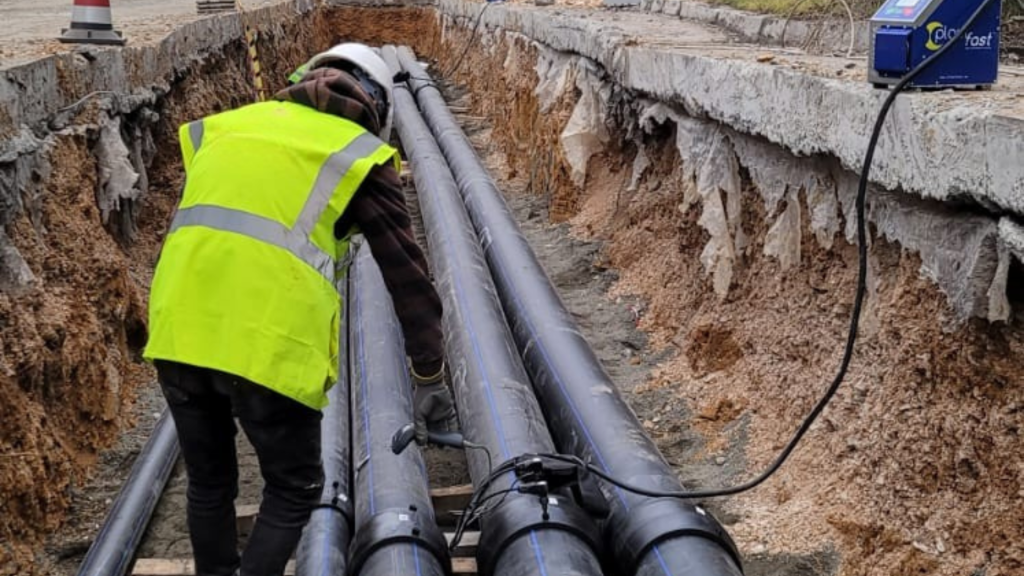
Modern utility infrastructure rarely develops in open, obstacle-free environments. Water, gas, and industrial pipelines must often pass beneath highways, railways, rivers, foundations, and dense urban corridors. These crossings represent the most critical points of any network. A single failure in these sections may lead to service interruption, environmental damage, or costly emergency excavation.
HDPE Fittings for Underground Utility Crossings provide engineers and contractors with a reliable, structurally resilient, and leak-free solution designed specifically for demanding underground conditions. Thanks to PE100RC material properties and electrofusion jointing technology, these systems combine flexibility, strength, and chemical resistance into a single integrated piping solution.
For utilities and industrial operators, the objective is clear. Reduce risk. Extend service life. Minimize excavation. Lower lifecycle costs. HDPE electrofusion fittings directly support these goals through predictable performance and simplified installation, even in confined or inaccessible areas.
This article explores how HDPE fittings enable safer trenchless crossings, adapt to complex subsurface layouts, and ensure long-term integrity where conventional materials often struggle.
Managing Crossings Under Roads, Railways, and Rivers
Crossings beneath transportation corridors and natural barriers represent one of the most technically complex aspects of pipeline design. Roads impose constant dynamic loads from vehicle traffic. Railways generate vibration and cyclical stress. Riverbeds introduce hydrostatic pressure, erosion, and soil movement. Traditional rigid piping systems may crack or fatigue under these conditions.
HDPE Fittings for Underground Utility Crossings address these challenges through material elasticity and joint continuity. PE100RC does not behave like brittle materials. Instead, it absorbs stress and distributes loads along the pipe wall, reducing localized concentrations that typically lead to failure.
During installation, pipelines are subjected to pulling forces, bending radii, and friction against soil or rock. HDPE fittings maintain integrity throughout these stresses, allowing contractors to install long sections with minimal joints.
One of the key advantages of HDPE systems is compatibility with no-dig construction. Utilities can complete crossings without cutting asphalt or interrupting rail services. This reduces:
- traffic disruption
- noise
- dust
- restoration costs
- project duration
For municipalities, this translates into faster approvals and improved public acceptance.
Long-term reliability in buried conditions
Once installed, the pipeline must operate for decades without intervention. HDPE fittings are immune to corrosion and electrochemical attack. They do not require protective coatings. This eliminates maintenance complexity and reduces operational risk in hard-to-access crossing zones.the need for coatings typically required for metallic systems.
Structural Flexibility for Complex Subsurface Layouts
Underground environments are rarely predictable. Existing utilities, foundations, ducts, and geological obstacles often force designers to route pipelines along curved or irregular paths. Rigid materials demand straight alignment and additional fittings, which increase weak points.
HDPE Fittings for Underground Utility Crossings and Obstacles provide the flexibility required for modern subsurface engineering. Controlled bending allows pipelines to follow natural terrain and avoid interference without sacrificing mechanical strength.
This flexibility improves both design and installation efficiency.
Adaptability to ground movement
Soil settlement, seismic activity, and seasonal expansion can introduce unexpected displacement. HDPE accommodates these movements through elastic deformation rather than cracking. This reduces the likelihood of leaks and emergency repairs.
Simplified hydraulic design
Fewer fittings mean smoother internal surfaces and lower head losses. Engineers benefit from:
- improved flow efficiency
- lower pumping energy
- reduced pressure drops
- more predictable hydraulic behavior
These advantages become significant over long pipeline distances.
Mechanical robustness in high-load areas
Industrial yards, logistics centers, and railway corridors expose buried utilities to constant surface loads. PE100RC maintains dimensional stability and resists impact even under heavy mechanical stress. This ensures that crossings remain protected regardless of surface activity.
Electrofusion Solutions
HDPE Fittings for Underground Utility Crossings and Obstacles rely on electrofusion technology, which offers precise, compact, and controlled welding.
Embedded heating coils generate uniform heat that melts both pipe and fitting surfaces. Once cooled, the connection forms a monolithic structure with the same strength as the pipe itself.
Fully sealed monolithic joints
Because no gaskets or threaded parts are used, the joint has no mechanical weak points. This is critical in underground crossings where inspection is difficult. The fused connection prevents:
- infiltration of groundwater
- exfiltration of fluids
- soil contamination
- structural weakening
Digital traceability and quality assurance
Electrofusion control units record each welding cycle. Utilities can track parameters and maintain documentation for future audits. This level of control improves reliability and supports asset management strategies.nce and long-term asset management. Utilities gain confidence that every joint meets design specifications.
Applications of HDPE Fittings for Underground Utility Crossings in Plastitalia Projects
HDPE fittings for underground utility crossings are not limited to a single sector. These solutions are widely applied across Plastitalia’s core markets, including potable water distribution, gas systems, wastewater rising mains, industrial plants, and infrastructure systems.
In municipal water and gas projects, crossings under roads and railways require leak-free electrofusion joints that remain maintenance-free for decades. In wastewater and industrial applications, buried pipelines must resist corrosion, abrasion, and soil stress without coatings or mechanical reinforcements.
Plastitalia supports these projects with a complete portfolio of PE100RC electrofusion fittings, custom geometries, and technical assistance during design and installation. This application-driven approach allows engineers and contractors to adopt HDPE systems with confidence, even in the most constrained underground environments.
Conclusion
Underground crossings are the most sensitive sections of any utility system. Failure is costly and often disruptive. Engineers therefore require materials and jointing methods that guarantee durability, flexibility, and leak-free performance.
HDPE Fittings for Underground Utility Crossings and Obstacles deliver exactly these benefits. PE100 material resists mechanical stress and corrosion. Electrofusion technology creates monolithic, fully sealed joints.
For municipalities, contractors, and industrial operators, this combination means fewer failures, lower maintenance costs, and longer service life. Selecting HDPE electrofusion fittings is not only a technical decision. It is a strategic investment in safer and more resilient underground infrastructure.